


Energy savings is the reason most facilities buy HVLS fans. The numbers hold up.
What they do not do is transfer cleanly from one building to another. Your savings depend on your HVAC setup, your square footage, your ceiling height, your climate zone, and how many hours a year the fans actually run. Here is a framework for working out HVLS fan ROI on your own building before a salesperson works it out for you.
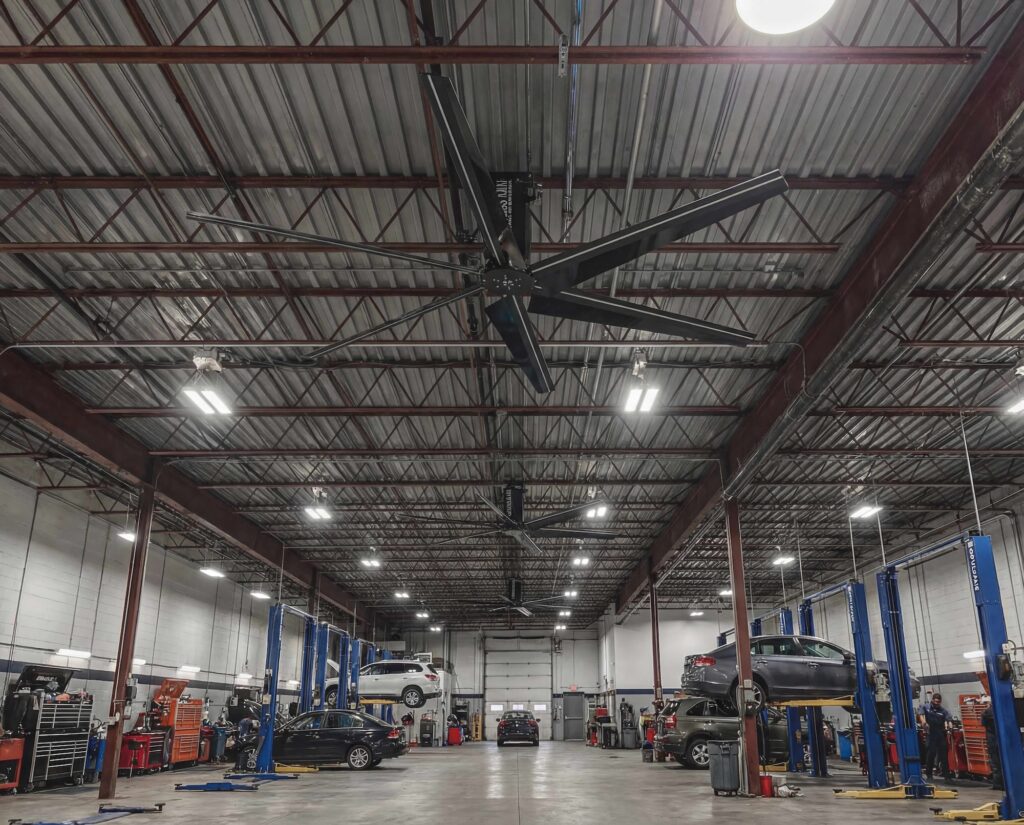
The Mechanism Behind HVLS Energy Savings
Two separate mechanisms. Cooling load in summer, heating load in winter.
Summer first. An HVLS fan produces a wind chill effect that drops perceived temperature at floor level by 8 to 12 degrees Fahrenheit. Actual air temperature does not change at all.
That lets you raise the thermostat. Four to eight degrees is typical, with no complaints from the floor. Commercial HVAC cooling consumption falls roughly 3 percent per degree of setpoint increase, so six degrees is about 18 percent off your cooling load.
Put real numbers on it. A 200,000 square foot facility spending $180,000 a year on cooling saves around $32,400.
Winter is a different problem with the same fix. Warm air rises and stacks against the ceiling, which is thermal stratification, and in a 30 foot warehouse the spread between deck and floor can top 20 degrees.
Run the HVLS fans in reverse at low speed and that trapped ceiling air comes back down where people are. You lower the heating setpoint without lowering floor temperature.
Buildings above 20 feet of ceiling consistently report heating load reductions of 20 to 30 percent.
What HVLS Fans Actually Cost to Run
A 24 foot HVLS fan pulls about 1.5 kilowatts wide open.
At $0.12 per kWh that is $4.32 a day if you never shut it off. Call it $1,577 a year. Fifteen fans covering 300,000 square feet run about $23,600 annually at full tilt, which is a rounding error against what they take off the HVAC bill.
And almost nobody runs them wide open. A VFD scales speed to conditions, so mild weather and empty shifts cost you less than the numbers above.
Not sure which HVLS fan size you need?
Humongous Fan builds American-made HVLS industrial ceiling fans from 8 to 24 feet in Cleveland, Ohio. Give us your square footage and ceiling height and we will size the fan for you.
Typical ROI Timelines
Most commercial HVLS fan installations pay for themselves in 18 to 36 months.
Three variables set where you land in that range. Facility size, local energy cost, and annual operating hours. Hot climates running HVAC hard year round pay back fastest. A single-shift climate-controlled warehouse in a mild region takes longer, but it still gets there.
There are secondary savings worth counting too.
HVAC equipment running at reduced load needs less maintenance and wears more slowly, particularly compressors. Absenteeism drops. Error rates drop. Those are harder to put on a spreadsheet, but they are not zero, and facility managers who have lived through a bad August will tell you exactly what they are worth.
Get a Facility-Specific Savings Estimate
Generic savings estimates only get you so far.
The real number comes from your utility bills, your HVAC specs, your floor area, and your ceiling height. Humongous Fan runs that analysis as part of the quote. Contact us and get a figure based on your building instead of somebody else’s.
Industry Solutions: How HVLS fans cut energy costs in warehouses, manufacturing plants, food processing facilities, and retail spaces.


